

This is Part II of III, be sure to read Part I and Part III for the full story and context.
Legalism is the idea that our standing before God, our righteousness, is determined by our ability to conform to rules. Legalism tries to accomplish through legislation what only the Holy Spirit can accomplish through the heart.
Legalism is never dormant. It is not something you can neglect. Its very nature is satanic.
Whoa.
You might think that language is a little strong, but let’s think about legalism; the idea that we can, through our own power, based on what we do or don’t do, make ourselves right before God. Does this not completely negate the finished work of Jesus? If Jesus died and rose again to fulfill the law and conquer death, but we still have to do a *little* more on our end in order to be righteous, then the Gospel is a lie. Anything that says, “Jesus plus…” is a lie straight from the pit of hell.
Satan operates in legalism. Work harder. Strive more. Compare. Create hierarchies. Argue. Debate. Be angry. Be afraid. Distrust. Hide. Hold onto bitterness. Build the case.
Legalism is satanic. It kills churches. It kills pastors. It keeps us hopeless. If you ignore legalism, it will eventually divide and destroy you and your church.
The Jen of 6 years ago knew none of this.
After three years of revitalization our church was seeing numerical growth. It had been slow and steady, but it was so exciting to see seats full, a nursery bustling, and the coffee cart (yes, it remains!) running out of cups.
With growth came more work to be done; we needed help.
To be clear, not everyone who offers to step up and serve at church is looking for a platform of power, but this is an area to exercise extreme patience and caution as a church leader. Just because someone is willing does not mean they are qualified or that their motives are pure. Better to live with a gap than to promote someone too quickly.
What began to happen within our church from certain members was this pattern of offering to help, and then slow accumulation of power and influence. It’s difficult to describe how this occurred because it was very, very subtle.
This can show up as a slight shift in the contents of a Sunday School class, or an offer to take over an event the leadership decided to cancel. A quiet “question” during church meetings about the leadership’s decisions on the church building, the order of service, the sermon series, etc. Using phrases like, “people are saying…” to sow seeds of doubt. Stirring up quiet grumbles amongst the flock, stoking the fire of discontentment.
These actions don’t always look malicious at face value, and in most circumstances they are coming from good intentions, but in a stronghold of legalism, what was happening was an intentional and targeted tactic of building distrust in leadership.
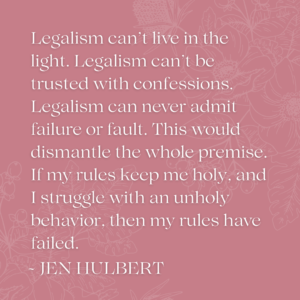
Wherever Aaron had been vulnerable in his sermons or small group discussions, those faults and failures were tucked away to use as weapons against him. Legalism can’t live in the light. Legalism can’t be trusted with confessions.
Legalism can never admit failure or fault. This would dismantle the whole premise. If my rules keep me holy, and I struggle with an unholy behavior, then my rules have failed.
So legalism keeps everything in the dark (Satan’s favorite place), and if you make the mistake of sharing a vulnerability in front of a legalist, they will latch onto that in order to place themselves above you in all ways, and to throw in your face the minute you are in opposition to them. The measuring stick never goes away.
Legalism thrives when it has God’s image bearers living in shame, fear, and doubt. This is why we can accurately say legalism is satanic. Not only is it an operating system of shame, it is removing the Holy Spirit from the picture and instead placing our own preferences and convictions as the conscience of everyone around us.
For us this culminated in a battle over worship.
 I want to intentionally not get into the specifics of this fight because I know the enemy can use details like that to distract from the point. So, without distracting, I will say the worship war was really a Trojan Horse for power. It is a hot-button subject that is easy to get people fired up about, and legalists love to create discontentment and division.
In our situation, what was in reality a personal conviction about music, was publicly presented as an issue that implicated our entire church leadership in sin because they did not share that conviction. Rather than allowing room for individual conscience and the Spirit’s work in each person’s heart, there was an attempt to legislate through legalism what only the Holy Spirit can accomplish.
But God is so good.
It really is His church.
Praise the Lord, this issue three years ago did not completely tear apart our church; it was resolved and it was handled with grace and integrity. The attacks launched at leadership fell flat because leaders were living with integrity, accountability, and character. An accusation against someone who is above reproach will not hold water.
We fought for freedom, we made mistakes, and we learned so much through the process. We ended that season as a smaller church (yes, people left), and we were a little bruised (yes, there were wounds), but we were free. We were aligned. We were able to discern what was existing in our community as legalism and the freedom we were called to as a church because when you know what you’re about, you can easily say no to the things that distract from that.
Clarity brings unity.
In a lot of ways I wish we hadn’t had to walk that road. My heart breaks for the way things went, the pain people experienced, but God didn’t waste it. He’s not responsible for brokenness, but He certainly isn’t limited by it. He uses crooked sticks to draw straight lines, and He uses suffering to help us grow in our dependence upon Him. As a church, with the root of legalism exposed but not completely gone, we were about to learn a lot about how dependent we needed to be.
I’ve often compared church revitalization to buying a fixer-upper.
You buy it knowing there’s work to be done, but it’s not until you start tearing down walls and pulling up carpet that you really have a grasp on the mess you’re dealing with. Mold, random hot wires, a copper pipe under the living room rug, a door that leads to nowhere (can you tell I’ve been through this personally?). You see the potential in the home, and you want to maintain the structural integrity, but you know some things have got to go or this thing is uninhabitable.
For the first time at church, I felt like the walls were down and we knew what we were dealing with.
And everything fell perfectly into place and we never struggled again.
Ha! If only!
Now that the toxic issue of legalism had been exposed, it was time to get to work building the church back up.
Read more in Part III: Free as a Bird.
Taking it Further:
1. How does the phrase, “legalism is satanic” sit with you? Does it feel too harsh? Why is that?
2. What is the difference between being legalistic and being conservative? How can we honor God while still keeping our hearts humble?